
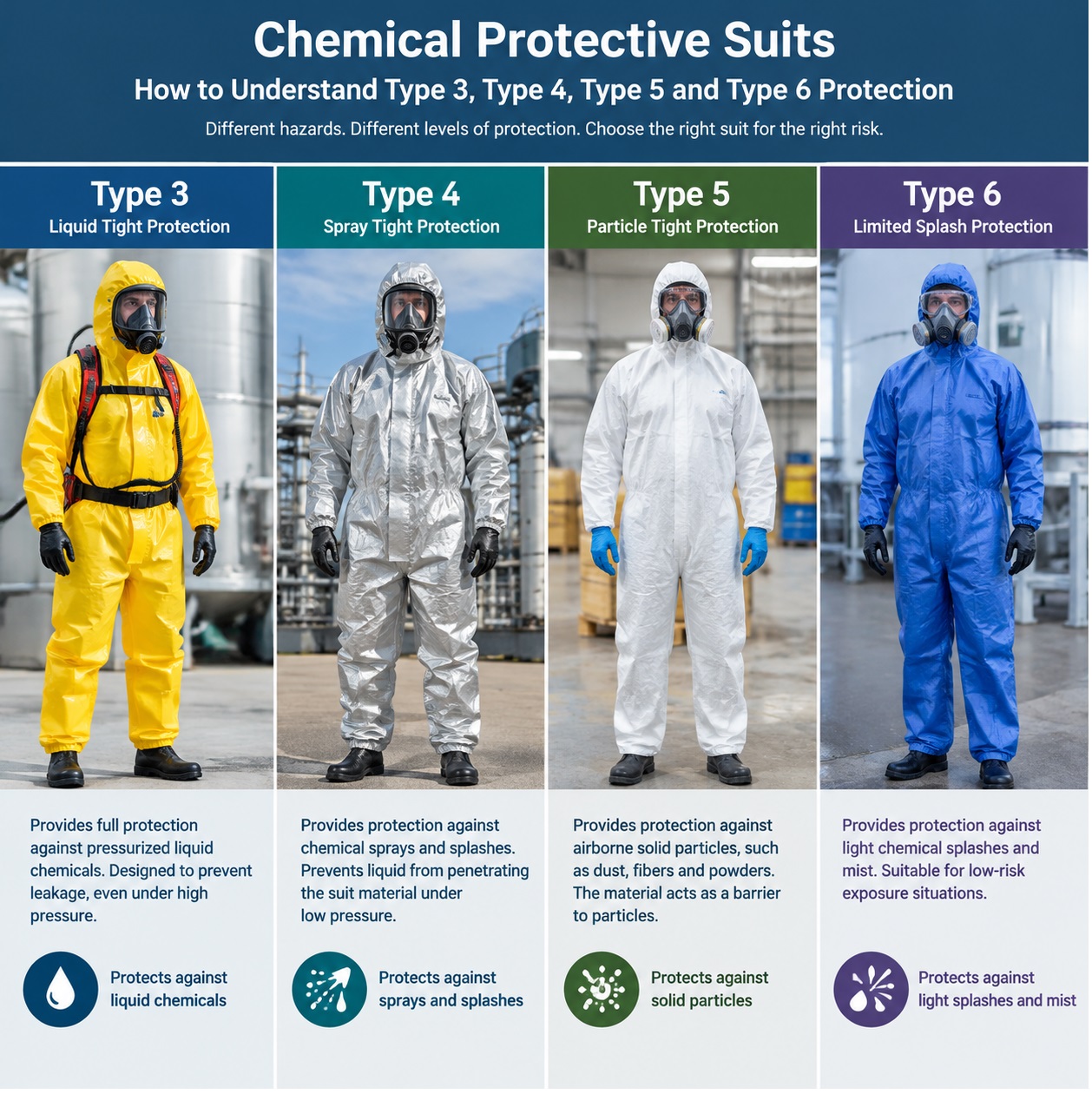
 Walk into any safety equipment catalog and you will see the numbers staring back at you: Type 3, Type 4, Type 5, Type 6. They look like a ranking system, so most buyers assume higher means better. That assumption costs money, and sometimes it costs more than money. The truth is that these numbers describe entirely different kinds of protection, not rungs on a ladder. A Type 6 suit is not a weaker version of Type 3. It is a different tool for a different job, and using it in the wrong scenario is just as dangerous as using a Type 3 suit where a Type 6 would have done the job safely for a fraction of the cost and discomfort.
Here is the framework behind the labels. These classifications come from European standards, primarily EN 14605 for liquid protection and EN ISO 13982-1 for particle protection, and they describe how a suit performs against specific physical states of a hazard. The key word is state. Is the chemical a pressurized jet of liquid? A fine mist? A cloud of dry powder? A light splash? Each Type answers one of those questions, and the suit that protects you from a high-pressure spray line may be completely wrong for airborne dust, even though it looks heavier and more serious.
Type 3 is the heavyweight of liquid protection. It is tested against a concentrated jet of liquid aimed directly at the suit, the kind of exposure you would face when opening a valve on a pressurized line or working near a ruptured hose. The fabric is typically a robust multi-layer laminate, and every seam is sealed, often with taped or welded construction. When you see workers in full encapsulating chemical protective suits with hoods, visors, and attached gloves dealing with tanker spills or chemical transfer operations, you are usually looking at Type 3 territory. It is hot, expensive, and restricts movement, and there is a reason for all of that: nothing less would survive a direct liquid strike.
Type 4 steps down one notch, but only one. It handles liquid spray and splashes rather than a focused jet. Think of a worker cleaning equipment with a pressure washer, or someone in a facility where pipes occasionally mist or drip. The suit still needs sealed seams and liquid-tight construction, but it does not have to withstand the full force of a directed stream. In practice, many Type 3 suits also carry Type 4 certification, which is why the two often appear together on labels. If your hazard is spray, Type 4 gives you solid protection with somewhat better breathability and flexibility.
Type 5 is where the logic shifts entirely, because the hazard is no longer liquid. It is solid particles. This is the suit you want for asbestos abatement, pharmaceutical powder handling, or any environment where fine dry dust hangs in the air and settles on everything. Type 5 testing focuses on inward leakage of airborne particles, and the critical features are the fabric’s filtration capability and the way the suit seals at the wrists, ankles, and face. A Type 5 suit does not need to be liquid-tight, and it will not protect you from a chemical splash. Put a Type 5 suit in a wet environment and you have essentially dressed your worker in a filter, which is the opposite of what you want.
Type 6 covers limited liquid splash, the lightest of the four. A small amount of liquid, a brief contact, a low volume of spray that does not saturate the fabric. Laboratories, paint shops with water-based products, and light maintenance tasks often fall into this category. Type 6 suits are lighter, cheaper, and more comfortable, and they are genuinely adequate when the exposure is genuinely limited. The danger is that people buy them because they are affordable and then use them in situations that demand Type 4 or Type 3 protection, and the suit fails quietly until it fails loudly.
So how do you choose? Stop asking which Type is best and start asking what your hazard actually looks like. If a chemical can hit your suit as a pressurized stream, you need Type 3. If it arrives as spray, Type 4. If it is dry and airborne, Type 5. If it is a brief, low-volume splash, Type 6. Then layer in the chemical compatibility question, because a suit can be perfectly rated for jet spray and still be the wrong material for the specific substance you are handling. The Type number tells you the physical form of the threat. The fabric data tells you whether that threat will eat through the suit.
One more thing worth saying plainly: comfort is not a luxury in this decision. A worker in an overheated Type 3 suit who has to take it off early, or who cannot move freely enough to do the job safely, is not protected. Overprotection is a real failure mode, and it shows up as heat stress, fatigue, and cutting corners. The right suit is the one that matches the hazard and can actually be worn for the duration of the task. That is the balance the Type system is designed to help you find, and once you understand it, the numbers stop looking like a ranking and start looking like a map.